Building an ADU First During a Fire Rebuild in Los Angeles
Homeowners in Los Angeles can now legally move into a detached ADU while their primary residence is being rebuilt after a fire. This guide explains the permit and utility process.
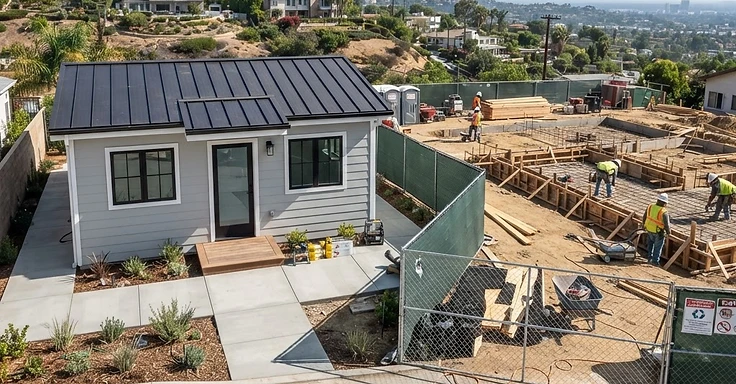
When a wildfire hits your neighborhood, the road back is tough. If you own a home in Pacific Palisades, Brentwood, Topanga, or Altadena, you probably already know the score: rebuilding takes 14 to 24 months. Between the structural engineers, architects, insurance adjusters, and the actual build, paying rent elsewhere eats up your budget fast.
We get asked this all the time: Can I build my detached ADU first, move in, and live on the property while we rebuild the main house? For years, California building codes made this a headache. City departments wouldn't give you a Certificate of Occupancy for an ADU unless the main house was already standing. They defined an ADU as accessory to a primary dwelling, so they wouldn't sign off on you living in the back unit first.
That is not the case anymore. Thanks to new state laws and local emergency orders, building the ADU first is legal. It is a solid move for your wallet and your logistics if you are rebuilding after a fire in Los Angeles City or the county. But you have to coordinate everything right with the plan-check folks, the utility companies, and the fire department to pull it off.
Key Takeaways
- Under California state legislation (AB 462) for disaster-declared areas, you can get a standalone Certificate of Occupancy to live in a detached ADU before we finish your primary residence.
- Thanks to Mayor Bass Emergency Executive Orders, we can get you fee waivers on plan checks and building permits for disaster-impacted rebuilds in Los Angeles City. This saves you $12,000 to $28,000.
- So, if you use pre-approved standard plan catalogs, we can cut LADBS and LA County Public Works plan-check approval times down to just 1 to 3 business days.
- For standalone ADU utility activation, you need an independent permanent electric meter base or an LADWP or SCE approved dual-meter pedestal.
- We see detached ADU construction costs in Los Angeles running $275 to $450 per square foot. But that gets you into a place of your own in 5 to 8 months while we handle the primary rebuild.
The 2026 Statutory Framework
We start an ADU-first build by looking at the rules that protect your project. Back in the day, city plan checkers wouldn't sign off on an accessory unit until your main house passed framing or final inspection. If you were stuck with just a dirt pad, your ADU sat empty.
But state laws changed. AB 462 says if you are in a disaster-declared county, a detached ADU gets its own permanent Certificate of Occupancy. It just needs to meet life-safety codes. You don't need the main house framed or finished. If you are in the Coastal Zone, AB 462 makes the Coastal Development Permit process faster. Local planners have to review your complete application in 60 days. The California Department of Housing and Community Development (HCD) stays on top of cities to make sure they follow state ADU rules. They remind building departments that they can't throw extra restrictions on your disaster lot.
So, looking at the city level, Mayor Bass signed Emergency Executive Orders to clear out financial roadblocks here in Los Angeles. If you were hit by a fire, you qualify for waivers on building permit fees and plan-check fees for rebuilds. These exemptions cover detached accessory units added to your recovery plans. We want to keep that cash in your bank account while we mobilize the site.
Permitting Sequence: LADBS vs. LA County Public Works
Where you live changes how you file your permits. We deal with the City of Los Angeles through LADBS. But if you are in unincorporated areas like Altadena, you go through LA County Regional Planning and LA County Public Works.
The City of Los Angeles (LADBS) Pathway
If your lot is in the city, head to the One-Stop Rebuilding Center on Sawtelle Boulevard. You can find the details on the LADBS Wildfire Recovery portal. They keep the Bureau of Engineering, LADWP, the Fire Department, and LADBS staff in one place.
We suggest you pull your ADU permit separately instead of waiting for your main house plans to clear. If you group a 4,000-square-foot custom home with an 800-square-foot ADU, you are stuck on the timeline of the big house. So, split it up.
- Step 1: File a site plan that shows both the house and the ADU, but list the ADU as Phase 1 so we can start digging.
- Step 2: Pick an LADBS pre-approved standard plan. They have catalogs for studios, one-bedrooms, and two-bedrooms. Since those plans are already checked, we get clearance in 1 to 3 business days. That beats the 30-day wait for custom math.
- Step 3: Clear the zoning stuff like 4-foot setbacks, height limits, and utility easements. Then we pull the permit.
- Step 4: Send in the custom plans for the main house as their own project. Your architect can keep refining those details while we are already framing the ADU.
The Unincorporated LA County Pathway
For properties in areas like Altadena, everything goes through LA County Public Works and Regional Planning. Just like the city, the County has standard ADU designs that speed things up. They let us run reviews in parallel. You just have to make sure your plot plan shows the fire department vehicle turnarounds, where we will stage our materials, and separate utility lines. We do not want your main home construction blocking your access once the ADU is finished.
Utility Sequencing
The biggest hurdle to living in your ADU before the main house is back is getting the utilities right. Usually, an ADU pulls power and gas from the main house. But if a fire took that house, you have no main panel or connection point.
LADWP and Southern California Edison (SCE) Power Strategy
Don't count on a standard temporary power pole for living in an ADU. T-poles are just for running saws and lights. Building inspectors won't sign off on a Certificate of Occupancy for a temporary meter.
So, we coordinate with LADWP or SCE to get a permanent service connection early. We install a freestanding, utility-approved meter pedestal at your property line or near the driveway. This pedestal holds two meters: one for your ADU and another for the future house. The ADU side gets juice right away, and we keep the main meter locked until that house passes inspection.
Sewer Lateral Tie-Ins
We need to handle your sewer lateral before we pour the ADU foundation. Wildfires often lead to tree root intrusion, crushed clay pipes, or damage from heavy equipment clearing debris. Before we connect anything, we have a licensed plumber run a camera from the cleanout at the property line to the city main. If the line is good, we run the ADU pipe directly into the private lateral. We need an independent plumbing permit and inspection for this before we backfill any trenches.
Fire Flow and Fire Department Clearances
Rules for life safety and water delivery don't bend in Very High Fire Hazard Severity Zones. In LA County, we have to finish the Fire Department review. This confirms your site hits the right fire flow, typically 1,000 to 1,500 gallons per minute at 20 psi. It also confirms the ADU sits within 150 feet of a hydrant or approved road for a hose pull. If the city water flow isn't enough, you might need on-site water storage tanks with draft connections.
Achieving Early Certificate of Occupancy
Passing framing is just the first step. You need to clear final inspections to get that standalone Certificate of Occupancy if you want to move into your ADU while we finish up the rest of the lot.
We have to get the inspector to sign off on a few specific things before you can officially crash there:
- Safe, Unobstructed Egress: We need to give you a clean path to the street. It has to be hardscaped, lit, and totally clear of trenches or construction debris.
- Safety Fencing: We’ll put up 6-foot chain-link fencing with a privacy screen. This creates a hard barrier between your living space and the heavy equipment or trucks running on the rest of the site.
- Fire Sprinkler Sign-Off: If the main house has them, your ADU needs them too. We also install them if you are in a wildfire zone. The hydrostatic test and backflow prevention have to be locked in before we even touch the drywall.
- Title 24 Energy and Solar Mandates: We build to meet all California Energy Commission Title 24 standards. And unless your lot is too shaded for it to make sense, your new detached ADU gets its own solar array.
- Operational Life Safety: Everything has to work. We’ll verify the smoke and carbon monoxide detectors, make sure the kitchen vents are running, and check that those emergency egress windows open just like they should.
Cost and Execution Schedules
Building your ADU first is a smart financial move if you're recovering from a fire. Instead of burning $4,000 to $7,000 every month on a rental, you put that money right back into your own lot.
We generally see construction costs for a high-performance, wildfire-hardened detached ADU around Los Angeles land between $275 and $450 per square foot. It all comes down to what we find in the soil and the finishes you pick. Custom single-family home rebuilds are a different story, usually running from $450 to $800+ per square foot.
- Waived Fees: If you qualify for disaster relief orders from the City and County, you'll save about $12,000 to $28,000 on city fees, school impact fees, and plan-check surcharges.
- Standard Plan Savings: We can pull an architectural plan from the LADBS or County standard plan catalog. This keeps custom engineering and design costs down by $8,000 to $18,000.
- Timeline: An ADU built from standard plans clears plan check in 1 to 3 business days. We can have that finished in 5 to 8 months. Custom homes are a long haul; they take 4 to 8 months just for design and permits, plus another 14 to 24 months to build.
And if we wrap up your ADU by month 6 or 7, you're back on your own property. You can keep an eye on the primary house build from your backyard and get your routine back on track.
Wildfire Hardening for Your New ADU
We know rebuilding in Southern California means we need to build better. If you lost your home to brush fires or flying embers, your new ADU has to follow California Building Code Chapter 7A standards for the wildland-urban interface. You can check the official CAL FIRE specs for the exact details on how we protect these structures.
We focus the build on non-combustible materials. We install fiber-cement siding, standing-seam metal roofs, and dual-pane tempered windows. And we use enclosed, non-vented eaves or fire-rated ember-resistant intake vents. So, we ditch the combustible deck materials. We also make sure you have a 5-foot non-combustible zone around the ADU slab. This stops embers from catching on anything and keeps your living space safe while we work on your main house.
How 1 Smart Build Guides Your Fire Recovery
Dealing with fire recovery is tough work. But you don't have to face the City of Los Angeles, LADWP, or LA County Public Works by yourself. At 1 Smart Build, we are a licensed design-build general contractor (CSLB #1076428) based right here in Woodland Hills. We handle projects for homeowners all over the San Fernando Valley, Westside, South Bay, and San Gabriel Valley.
We keep your whole project in-house. We tackle site feasibility assessments, utility demarcation, standard plan customization, expedited disaster permitting, and fire-hardened construction. And we sequence your build so you can move into a finished ADU while we work on your main house.
Want to see if your lot qualifies for expedited ADU permitting, early utility drops, or local fee waivers? Just reach out to our team at 1 (866) 419-8840. You can also drop by our Woodland Hills office at 21243 Ventura Blvd #133 or set up a free site consultation on our website.
DISCUSS YOUR PROJECT WITH 1 SMART BUILD
Licensed, bonded and insured design-build general contractor serving Los Angeles County and Southern California. Tell us about your property and goals, and we'll walk you through feasibility, permitting and a clear plan.