Do You Need Solar Panels and Batteries for an ADU or Room Addition in Los Angeles? (2026 Code Guide)
Wondering if your Los Angeles room addition or new ADU requires solar panels and battery storage under the 2026 Title 24 code? Here are the rules, exemptions, costs, and permit timelines.
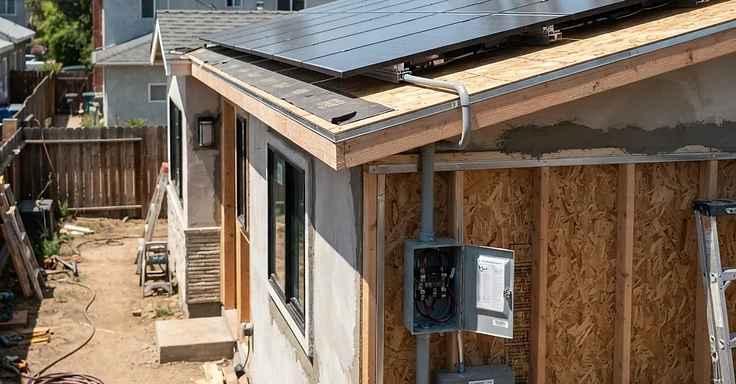
Planning an ADU or adding square footage to your L.A. home? You have likely seen conflicting info on clean energy rules. Plenty of headlines claim California mandates solar on every new build. So, homeowners from Sherman Oaks to Silver Lake figure that a 400-square-foot primary suite or a guest house means shelling out for solar arrays and battery banks.
But the reality under California's Building Energy Efficiency Standards (Title 24, Part 6) is different. Building officials see room additions, detached ADUs, and garage conversions as separate animals. Everything depends on whether your project is a new standalone building or just an expansion of your current footprint.
We know that getting this right before you send plans to the Los Angeles Department of Building and Safety saves you serious cash on equipment and keeps you out of utility paperwork hell. Here is a breakdown of what the 2026 energy code requires for additions and ADUs across Los Angeles.
Key Takeaways
- Attached room additions do not trigger mandatory solar or battery storage requirements under California Title 24 Part 6.
- Newly constructed detached ADUs require dedicated solar systems, typically sized between 1.5 kW and 4.0 kW based on floor area.
- Garage conversions and Junior ADUs built within existing building envelopes are exempt from the solar mandate.
- An ADU qualifies for a solar exemption if the Solar Access Roof Area contains less than 80 contiguous square feet of unshaded space.
- Battery systems are not mandated for ADUs, though we often install them to help you meet energy performance standards.
- LADWP solar interconnection authorization usually takes 4 to 8 weeks after your final building inspection.
Room Additions vs. Detached ADUs: Where Title 24 Draws the Line
Lots of homeowners in LA get tripped up by how building codes define a new building. Per the California Energy Commission Title 24 Standards, a brand-new residential structure has to generate its own electricity. But the code sets clear boundaries between additions, detached dwellings, and conversions.
Attached Room Additions and Structural Bump-Outs
So, if we are building an expanded kitchen, adding a second story to your home in Mar Vista, or pushing out a primary bedroom suite in Studio City, you don't have to install solar panels or battery storage. We treat room additions under existing residential building standards. You still have to meet requirements for envelope insulation values, high-efficiency window glazing, and HVAC duct efficiency. But, the addition itself doesn't trigger a mandate to add solar panels to your primary roof.
There is one catch. If your project means we have to demolish the primary structure down to the foundation, the building department calls it a new build. At that point, the whole house is subject to current solar mandates.
Newly Constructed Detached ADUs
When you build a standalone ADU in your backyard, building codes call that a new dwelling unit. Because it has its own roof, envelope, and electrical subpanel, it gets hit with mandatory solar requirements. You have to install a dedicated solar system on the ADU roof or show that we have expanded an existing main-house solar array to cover the electrical demand of the new dwelling.
Garage Conversions and JADUs
Converting an existing detached two-car garage into a permitted ADU or creating a Junior ADU inside your existing floor plan doesn't require solar panels. Under state guidelines verified by the California Department of Housing and Community Development, conversions of existing space skip the new-construction mandate. Sticking to the original permitted footprint keeps you in the alteration category instead of new construction.
The Documented Code Exceptions: When an ADU Skips Solar
Building a brand-new, ground-up detached ADU? You might still get out of installing solar panels. We see plenty of dense urban lots in places like Brentwood, Pasadena, and Mount Washington. The 2026 energy code has real-world exceptions for these spots.
It all comes down to the Solar Access Roof Area, or SARA. You can skip the solar panels if your project hits these marks:
- The 80-Square-Foot Rule: Your effective Solar Access Roof Area is under 80 contiguous square feet. This happens when mature trees, the neighbor's two-story house, or the hillside slope kill your roof space.
- Severe Shading Obstructions: If your roof gets less than 70 percent of open-sky potential due to external shade, you are clear.
- Planning Constraints: Sometimes local height limits or historic preservation rules make it impossible to angle your roof toward the sun.
We have to handle this during plan check with the Los Angeles Department of Building and Safety. So, your designer or energy consultant needs to put together a shade analysis. They will use site data to prove that your roof just cannot handle that 80-square-foot minimum.
Are Battery Storage Systems Required in 2026?
You might have heard the rumor that every new backyard home in LA needs a battery. That is not true. We don't see a mandate for energy storage in residential ADUs under the prescriptive pathway of Title 24.
But plenty of homeowners install them anyway. They know the grid and they look at the numbers.
Prescriptive vs. Performance Compliance
Your consultant runs your ADU plans through approved software. If your design has high-load electrical features, think vaulted ceilings, giant windows, or electric resistance heating, your project might fail its energy budget. So, adding a 5 kWh to 10 kWh battery gives you compliance credits. It balances out that glass-heavy design so you don't have to thicken your walls or scrap your window plans.
The Net Billing Tariff Reality
If we build you an all-electric ADU, you interconnect with the grid under the Net Billing Tariff. Sending excess midday solar power back to the grid only gets you wholesale export credits. If you put solar on an ADU but skip the battery, you export power when the sun is out and buy it back at high peak rates when your tenants crank the AC at night. A battery holds onto that midday power for you. It keeps your electric bills down.
Real-World Solar and Electrical Budgets
Budgeting for clean energy compliance means looking past the sticker price on the equipment. We have to account for utility tie-ins, the main electrical panel, and what the city charges for permits. Here is what we typically see for Title 24 compliance on Los Angeles ADUs:
- 2.5 kW to 4.5 kW ADU Solar Array: $7,000 to $14,000. That includes your panels, microinverters, roof racking, and our labor to get them running.
- Title 24 Energy Calculation Report: $350 to $750. You need a certified energy consultant to sign off on this.
- LADBS Electrical and Solar Plan Check Fees: $350 to $800. The city sets these based on your system size and the total project valuation.
- Electrical Main Panel Upgrade: $3,500 to $7,500. We often find that an older 100A main service just can't handle the load of a new ADU subpanel.
- Battery Storage System: $7,500 to $14,500 installed, before you factor in any federal clean energy tax credits.
Getting Through LADBS Plan Check and LADWP Interconnection
We need to coordinate with the city and the utility to get your system approved in Los Angeles. It takes some planning.
LADBS Plan Check Documentation
To pull your ADU permit, your plans need energy documentation that proves you meet solar code. We integrate those compliance forms right into your plan sheets. Your drawings will show the solar layout, where the conduit runs, inverter locations, and the roof load calcs. We have to prove your framing can handle the weight of the gear.
The LADWP Interconnection Timeline
Property owners here are often surprised by the gap between finishing the build and actually turning on the solar. Once we pass our final electrical inspection, you aren't done yet. You cannot flip that breaker. We have to submit a formal interconnection package to the LADWP. The utility needs to check that the transformer on your street can handle the extra load and they have to swap out your meter. Only then will they give you Permission to Operate. Expect this to take 4 to 8 weeks after the city signs off on your building permit.
Smart Design Decisions to Protect Your Budget
Don't let energy standards stall your project. We suggest you follow these steps.
- Evaluate the primary panel early: Get a licensed contractor to check your main electrical panel before you start designing your ADU. If you find out late that the utility wants a service upgrade, it adds time and cash to your build.
- Confirm garage conversion boundaries: Planning an ADU in a detached garage? Keep your layout inside those existing walls. If you tear them down to the slab, plan checkers might reclassify your project as new construction. That triggers full solar compliance.
- Maximize passive efficiency: We design wall assemblies with better insulation and cool roof materials. This drops the energy load. You might end up needing a smaller, cheaper solar array because of it.
Build Confidently with 1 Smart Build
Designing an ADU in Los Angeles takes a team that knows how architecture, structural engineering, and shifting energy codes actually work together. But get those Title 24 guidelines wrong, and you're looking at expensive corrections or paying for gear you didn't even need.
We are a licensed design-build contractor at 1 Smart Build (CSLB #1076428). We handle every phase of your project right here, from the initial architectural drawings and energy analysis to getting through plan check, finishing construction, and handling utility interconnection. And it doesn't matter if you are expanding a bungalow or putting up a detached ADU for extra income, we make sure your build stays compliant and hits the schedule.
So give 1 Smart Build a call at 1 (866) 419-8840 to evaluate your property and look over your site constraints.
DISCUSS YOUR PROJECT WITH 1 SMART BUILD
Licensed, bonded and insured design-build general contractor serving Los Angeles County and Southern California. Tell us about your property and goals, and we'll walk you through feasibility, permitting and a clear plan.