ADU Utility Trench and Subpanel Costs in Los Angeles: The 2026 Guide
Discover what detached ADU utility trenching, sewer falls, subpanels, and LADBS inspections cost in Los Angeles in 2026, from site work to meter tie-ins.
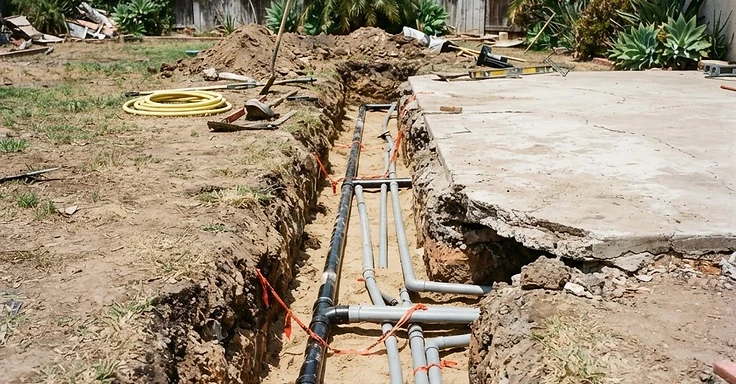
When you start looking at detached accessory dwelling unit designs in Los Angeles, you see clean floor plans and slick renderings. But you rarely see the real obstacle sitting in your backyard. We’re talking about 65 to 110 feet of dirt, broken concrete, or heavy tree roots. Plus, your primary sewer line is likely sitting at an elevation no one can predict until we dig. Connecting power, water, sewer, and low-voltage conduits from your main house to a new backyard dwelling? That is one of the most unpredictable cost centers we see in residential construction.
Key Takeaways
- Full detached ADU utility infrastructure in Los Angeles typically costs between $12,000 and $35,000 for combined sewer, water, electrical subpanel, and low-voltage lines.
- Unpaved backyard dirt trenching costs $80 to $180 per linear foot, while routing through existing concrete driveways or patios costs $200 to $350 or more per linear foot due to saw-cutting, haul-away, and repouring.
- LADBS plumbing code requires a gravity sewer slope of 1/4 inch per foot for 3-inch pipe. If your backyard slopes downward away from the street, a sewage ejector pump system adds $4,000 to $7,500 installed.
- Upsizing your main domestic water service line from 3/4-inch to 1-inch or 1.25-inch pipe is often necessary to meet water pressure requirements under the California Plumbing Code.
- Running a 100-amp to 125-amp subpanel feeder from your existing 200-amp main panel costs $4,500 to $9,500 and avoids the long service planning delays common with dedicated second-meter installations.
- LADBS mandates specific open-trench milestone inspections, including electrical conduit burial depth and plumbing pressure tests, before you cover any pipes with dirt.
You might see generic online estimates suggesting $2,000 to $5,000 for utility hookups. But if you are building in the City of Los Angeles in 2026, those numbers just don't hold up. We see real-world costs hit much higher. Between meeting the strict plumbing slope formulas of the Los Angeles Department of Building and Safety, sizing water lines for your fixture count, hitting LADWP feeder specs, and patching up concrete driveways, your budget needs to be realistic. So, plan on $12,000 to $35,000 for your full detached ADU utility package.
Trenching Costs Per Linear Foot
You are looking at 40 to 100 linear feet between your main house and the ADU. The surface we have to dig through dictates most of your labor costs. We typically charge $80 to $180 per linear foot for open dirt, turf, or garden soil here in Los Angeles. That covers our mini-excavator time, rough grading, bedding sand, and backfilling with mechanical compaction. Soft soil makes the job go fast. But if we hit hard-packed decomposed granite or shale rock, you should expect to pay toward the higher end of that range.
So, what happens when we hit your hardscape? Costs go up. We have to saw-cut that 4-inch reinforced concrete driveway, break out the slab, hand-dig around tight spots, and haul off the rubble. That brings the cost to $200 to $350 or more per linear foot. And we can't just toss the dirt back in once the pipes pass inspection. LADBS demands proper soil compaction, and we often have to backfill with a two-sack cement slurry mix under structural slabs. If your trench cuts across custom pavers, stamped concrete, or flagstone, expect extra fees for the specialized restoration work.
Sewer Lines and LADBS Gravity Slope Requirements
Your ADU waste line connection depends on gravity and the California Plumbing Code. A 3-inch ABS sewer line needs a 1/4 inch per foot fall, which is a 2% grade. But if we run a 4-inch line, code might allow a 1/8-inch per foot slope if the city approves and we keep the flow velocity up.
Think about that over a 60-foot run. A 1/4-inch drop per foot means we need 15 inches of vertical drop from the ADU to your main sewer line. So, if your main line exits the house at 3 feet deep and your yard is level, a gravity connection works. We just cut into your existing lateral, install a wye fitting and a two-way cleanout, then slope the pipe toward the ADU.
But plenty of LA lots don't have the right grade. On flat lots where the backyard sits 1 to 2 feet lower than the curb, you can't use gravity. It just won't work.
When a Sewage Ejector Pump Is Required
If your ADU sewer outlet sits lower than your main lateral, code forces us to use a grinder or sewage ejector pump. We sink an underground basin outside your foundation, drop in a submersible solids-handling pump, wire a dedicated circuit with an alarm, and plumb a pressurized line into the lateral. An installed sewage ejector pump system in Los Angeles runs between $4,000 and $7,500. It solves the grade problem, but it's mechanical and needs maintenance. We always prefer a gravity run if we can make it happen.
Water Line Sizing and Hydraulic Calculations
Don't just tap into a garden hose bib to feed your detached ADU. You'll deal with miserable water pressure. Imagine trying to shower while the front house runs its irrigation or flushes a toilet. It won't work. Per the California Plumbing Code, your LADBS plans need a Water Supply Fixture Unit calculation. We have to account for every sink, shower, water heater, dishwasher, and hose bib on the whole property.
Plenty of older LA homes sit on a 3/4-inch main line from the street meter. Once we add an ADU kitchen, bathroom, and laundry, that pipe usually isn't enough. We often have to bump you up to a 1-inch or 1.25-inch line. Replacing that supply pipe from the meter to the back yard runs between $2,500 and $6,000. The final price depends on how far we're running it and if we have to cut through any pavement. And if your plans require a fire sprinkler system, we have to install a backflow prevention assembly at the service point to keep the city water supply clean.
Powering the ADU: Subpanel vs. Dedicated Meter
You have two ways to get power to the unit. We can run a subpanel off your main house service, or we can request a separate meter from LADWP.
The 100A to 125A Feeder Subpanel
For most of our projects, running a subpanel feeder from the main house is the move. It is faster, it is cheaper, and we know exactly what we are getting into. If we upgrade your main panel to 200 amps, we install a double-pole 100-amp or 125-amp breaker right there. Then we run heavy-gauge conductors through PVC conduit. We bury that 18 to 24 inches deep and bring it over to a new subpanel in your ADU. And if you need to track what your tenant is using, we can pop a private digital smart submeter into that panel for $400 to $900. You won't have to deal with the utility company at all. The whole subpanel install usually lands between $4,500 and $9,500.
Dedicated LADWP Meter-Split
But maybe you want the tenant to get their own bill from LADWP. That means we have to do a meter-split. So, you should know that this creates some friction with the city. We have to send load plans over to LADWP Service Planning, and their engineering reviews can drag your project out by 4 to 10 months. Also, local transformers in older neighborhoods are often already tapped out. If adding your meter forces LADWP to upgrade a neighborhood transformer, your fees and wait times are going to spike. You are also on the hook for an LADBS-approved dual-meter socket base or a freestanding pedestal, which runs $8,000 to $16,000 or more.
The Shared Trench Strategy
Don't dig three separate trenches. We use a shared multi-utility trench to save you cash on earthwork. But it has to be laid out right to pass California Electrical and Plumbing code clearances. Plumbing codes say you can't put potable water pipes in the same horizontal trench as a sewer line unless you follow strict rules. We place your potable water on a solid shelf carved into the trench wall. It sits at least 12 inches above and 12 inches horizontally from the sewer pipe. Electrical power and low-voltage lines need their own space too. Our electricians run two parallel conduits. One carries the electrical conductors and the other holds your telecommunications. We keep those at least 12 inches away from your water and gas lines.
Navigating Tree Roots
Mature LA backyards are full of jacarandas, oaks, and sycamores. If we take a backhoe and trench through a root plate, we'll kill the tree. Plus, you’ll be on the hook for violating city tree protection ordinances. So, when we hit a root zone, we stop the machine. We use pneumatic air-spading to blow the dirt away rather than tearing up the roots. Then we route your pipes underneath those structural roots or slide them through steel sleeves for protection. But if we run into heavy roots, we’ll have to switch to hand-digging. Expect that to add $1,500 to $4,500 to your labor costs.
The Inspection Sequence
LADBS plays by a strict rulebook for sign-offs. If we backfill a trench before the inspector tags the job card, you get a stop-work notice. That means digging it all up again on your dime. We coordinate the steps to avoid that mess. We handle trench depth and bedding checks, rough plumbing hydrostatic head tests, water line pressure tests, and electrical underground conduit inspections. So, we make sure everything is prepped right. Before the final sign-off, the inspector double-checks your final panel bonding, ground rods, and fixture operation. Need more info on trade standards? Check out the Contractors State License Board and the California Department of Housing and Community Development.
Itemized Cost Blueprint for a 60-Foot Run
Here is what you are looking at for a 60-linear-foot utility run. We have to cross 35 feet of dirt and 25 feet of concrete patio.
- Trenching & Excavation: $11,000
- Sewer Drainage Infrastructure: $3,800 to $5,500
- Water Supply Extension: $1,800 to $2,800
- Electrical Feeder & Subpanel: $5,200 to $7,500
- Low-Voltage & Communications: $1,100 to $1,800
- Hardscape Restoration & Slurry: $2,400 to $4,200
- Permits, Engineering & Plan Check: $1,400 to $2,500
- Total Estimated Project Range: $26,700 to $35,300
If we have straight dirt access with no concrete to break up, your cost drops. That baseline usually sits in the $14,000 to $20,000 range. And keep in mind these are just planning figures. We cannot give you a fixed quote until we see what is actually buried under your soil.
Practical Steps Before Breaking Ground
- Call 811 at least two business days before you dig so utility operators can mark existing lines.
- Commission a private underground utility locator to sweep for unmapped pool pipes, irrigation, and legacy gas lines.
- Schedule a sewer scope of your primary house lateral to confirm its depth and condition.
- Inspect your main electrical service panel to confirm you have enough capacity for a new subpanel breaker.
Those underground utilities are the real foundation of your ADU. If you skip this, you will end up with backed-up drains, flickering lights, and major headaches at inspection time. So, we make sure those sewer, water, and electrical feeds are set up right from day one. At 1 Smart Build, we are a licensed design-build general contractor (CSLB #1076428) working with homeowners all over Los Angeles. We handle everything from the initial plans to the final paint. But if you want us to take a look at your specific site, use our online tool at /build-check. Or just call our team at 1 (866) 419-8840. And you can always stop by our office at 21243 Ventura Blvd #133 in Woodland Hills if you want to chat about your project.
DISCUSS YOUR PROJECT WITH 1 SMART BUILD
Licensed, bonded and insured design-build general contractor serving Los Angeles County and Southern California. Tell us about your property and goals, and we'll walk you through feasibility, permitting and a clear plan.