Bathroom Remodel Contractor in Los Angeles: A Planning Guide
Planning a bathroom remodel in Los Angeles? This comprehensive guide covers LADBS permits, California building codes, and realistic cost ranges for LA County homeowners.
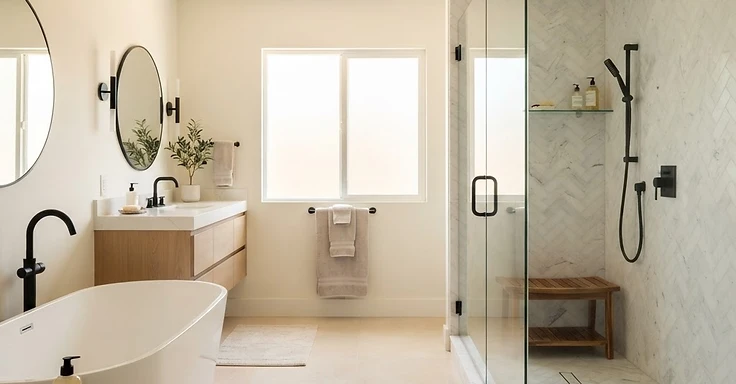
A bathroom remodel adds real value to your LA home. But it is a complex job. You are cramming plumbing, electrical, ventilation, tile, and critical waterproofing into a tiny space. Hiring the right bathroom remodel contractor in Los Angeles matters just as much as the tile and vanity you pick. Updating a mid-century bungalow in Sherman Oaks or a modern condo in Woodland Hills? The technical requirements stay high. You aren't just changing how a room looks. You are managing a high-moisture environment that can cause thousands in damage if we don't handle the behind-the-wall work right.
We put this guide together to help you plan your remodel. We will show you what a reliable contractor should walk you through before we touch any demo. You will see how the city approval process works and how to keep your project on a realistic timeline. We want to help you weigh the process and accountability, not just the bottom line, so you make a smart choice for your property here in LA County. And we will look at the specific codes enforced by the Los Angeles Department of Building and Safety. So, expect to learn how to budget for the unique labor market in Southern California. You will find that a successful project depends on clear communication and strict adherence to California building standards.
Key Takeaways
- The Los Angeles Department of Building and Safety makes you pull a formal permit if you move or add plumbing, electrical outlets, or structural walls.
- California Green Building Standards Code sets the max flow rate for new showerheads at 1.8 gallons per minute at 80 psi.
- You need 30 inches of clear space for a toilet. That is 15 inches from the center of the fixture to the closest wall or obstruction.
- Every bathroom with a shower or tub needs a mechanical exhaust fan. We have to make sure it pulls at least 50 cubic feet per minute for intermittent use.
- State law says we cannot ask for a down payment over 10 percent of your total price or $1,000, whichever amount is lower.
Start With How You Actually Use the Bathroom
Before you hunt for bids or pick out tile, figure out what you want. Every bathroom project hits different when it comes to scope, budget, permits, and your timeline. A lot of LA homes from the 40s and 50s have old galvanized pipes or ungrounded wiring. We have to address those guts before we talk about how the tile looks. So, categorize your project into one of these four types so we can give you an accurate estimate.
Defining Your Project Scope
- Cosmetic Refresh: We swap your vanity, fixtures, and paint. We do not touch your plumbing or open the walls. It is the fastest way to spruce up a place in Encino or Tarzana if your current layout works fine.
- Full Remodel in the Same Footprint: We pull out the old shower, tile, vanity, and fixtures but keep the plumbing where it sits. Most folks choose this because it saves them the heavy cost of trenching through a concrete slab to move a drain.
- Layout Change: You want to move the toilet or shower. That means we have to reroute the plumbing. It almost always forces a full permit and city plan check. We see this a lot when you decide to turn a tiny guest bath into a bigger master suite.
- Expansion: You are tearing into a closet or an adjacent room. That is structural framing. You will need an engineer, and the city will take longer to sign off on the plans.
We need to know how you use the space, your budget, and your deadline before we plan anything. You want a job that hits your needs without wasting money. If you plan to sell soon, a mid-range update usually nets you more cash than a high-end luxury job. But if this is your forever home in the Hollywood Hills, putting your money into quality materials and a custom layout pays for itself in comfort and durability.
Understanding Bathroom Remodel Costs in Los Angeles
Budgeting for an LA bathroom means you need to look at material prices and what labor actually costs around here. LA is pricey and our building codes don't cut you any slack. You're going to pay more for skilled labor than you would elsewhere. We see labor eating up 50 percent to 60 percent of your total budget. That makes sense when you think about it. You've got plumbers, electricians, tile guys, and waterproofers all trying to work in one tight room.
Typical Planning Ranges for LA Bathrooms
Every job is different, but these numbers give you a solid starting point. A budget-friendly full bathroom remodel in LA kicks off at $25,000 to $30,000. That covers standard fixtures, porcelain tile, and a store-bought vanity. Want something mid-grade with better materials and maybe a custom shower pan? You should budget $35,000 to $50,000. But if you’re looking at high-end luxury stuff like premium stone, custom cabinets, heated floors, or steam showers, be ready to spend over $60,000. The sky is the limit depending on your finishes.
Factors That Drive Up the Price
- Moving Plumbing: Shifting a toilet or shower drain adds $3,000 to $5,000. We have to cut into your subfloor or concrete slab to move those lines.
- Electrical Upgrades: Got an old panel? Adding modern GFCI outlets and high-powered fans might force an upgrade. That's another $2,500 to $5,000.
- Structural Changes: Taking out a wall to make the room bigger means hiring an engineer and putting in new support beams. That drives up your permit fees and labor hours fast.
- Custom Tile Work: Standard subway tile is quick. Intricate patterns, mosaics, or large-format tiles take way more time and precision to set right, so your labor bill goes up.
When we give you a quote, we make sure it’s itemized. If you get a quote that’s vague, watch out. You need to see a breakdown for demolition, rough plumbing, electrical, waterproofing, tile, and finish work. We provide this so you know exactly what you’re paying for and so we’re all on the same page about the scope of the job.
Navigating LADBS Permits and California Building Codes
In LA, you will need permits from the Los Angeles Department of Building and Safety (LADBS) for most bathroom remodels. If we are moving plumbing, changing electrical, or tearing down walls, you have to get a permit. Some folks try to skip this to save a few bucks. But that is a bad move. It will cause huge headaches when you try to sell your place or file an insurance claim. And unpermitted work might fail to meet the California Residential Code, which puts your safety at risk.
Why Permits Are Non-Negotiable
Permits make sure we follow current safety and efficiency rules. The 2022 California Green Building Standards Code (CALGreen) has strict water rules. Your new toilet cannot exceed 1.28 gallons per flush, and your faucets must stay at or below 1.28 gallons per minute. These rules protect our local water supply. An inspector checks your fixtures during the final walkthrough. If you put in non-compliant gear, you will have to rip it out and replace it before the job is signed off.
The Inspection Sequence
- Rough Inspection: We do this after framing, plumbing, and electrical are in, but before we close up the walls. The inspector checks that pipes have the right slope and the wiring is safe.
- Shower Pan Inspection: The inspector verifies your shower floor is watertight. They often run a flood test. We plug the drain and fill the pan with water for 24 hours to check for leaks.
- Final Inspection: Once we finish the job, the inspector comes back. They verify all fixtures work, your exhaust fan vents outside, and any electrical outlets near water sources have GFCI protection.
We handle all the paperwork and coordinate these inspections for you. That is part of what you pay for when you hire 1 Smart Build. You can look up a contractor through the California Contractors State License Board (CSLB) to make sure they are licensed to pull these permits. Hiring a licensed pro gives you protection and keeps your home up to code.
The Critical Role of Waterproofing and Rough-In Inspections
The part of your bathroom remodel that actually matters is the stuff disappearing behind the tile. Proper waterproofing is the only thing keeping your bathroom from turning into a disaster in a few years. In a shower, water gets through your grout lines no matter what. If we don't put a solid, continuous barrier behind that tile, your wood framing will rot. That leads to mold and major structural issues. That is exactly why we pay such close attention to the rough-in phase.
Modern Waterproofing Systems
Plenty of guys around Los Angeles still lean on the hot mop method. Sure, hot asphalt and felt paper work, but they are messy and stink up the whole job site. We prefer liquid-applied membranes or sheet systems like Schluter-Kerdi. These give us a consistent, factory-controlled thickness that handles complex spots like benches or niches without any headaches. You should always ask your contractor which system they are using and why they think it fits your home.
What Happens During the Rough-In?
- Plumbing Pressure Tests: Before we close up a single wall, the plumber pressurizes the lines. This proves there are no pinhole leaks in your new copper or PEX piping.
- Electrical Box Placement: The electrician sets the boxes for your outlets and switches. We make sure they meet every code-required distance from your water sources.
- Backer Board Installation: We never use standard drywall in wet areas. We use cement board or fiber-cement backers. California code is very specific about the materials allowed behind your shower tile.
- Ventilation Ducting: We run the ductwork for your exhaust fan directly to the outside. A lot of older LA homes have fans just venting into the attic, which is a major code violation.
Don't let anyone rush you through this part of the job. It is easy to get excited about the pretty tile and the new vanity, but your project is only as strong as these hidden systems. At 1 Smart Build, we keep the rough-in clean and organized. We never close up the walls until the city inspector gives us the green light. Taking our time now prevents expensive tear-outs later and makes sure your investment stays protected from water damage.
Designing for Small Spaces: Layout and Fixture Selection
Lots of homes in Los Feliz or Mar Vista have bathrooms that feel tight these days. When you are squeezed for square footage, every move counts. You don't just need the room to look bigger; it has to work better. We suggest starting with a floating vanity. By leaving the floor open under the cabinet, you trick your eyes into seeing more volume. And you should look at wall-mounted toilets. These hide the tank inside the wall, saving you 8 to 12 inches compared to a standard floor-mounted unit. That shift makes a massive difference in a narrow room where every inch of clearance matters for building codes.
Fixture selection comes down to scale. If you drop a massive, ornate vanity into a 5x8 bathroom, the whole place will feel cramped. So look for slim-profile sinks and narrow faucets instead. We can also save you space by installing a walk-in shower with a clear glass partition rather than a tub. This gets rid of the visual block created by a shower curtain. Think about going vertical for storage. Recessed medicine cabinets and built-in wall niches keep your surfaces clean without eating up floor space. Lighting is huge for how big a room feels. Don't rely on just one overhead bulb. We put lights inside the shower and add task lighting by the mirror. Light colors like white, soft gray, or light beige help reflect light and keep things feeling airy. But you should check the water flow requirements set by the California Energy Commission to ensure your new fixtures hit state conservation standards before you buy them.
How 1 Smart Build Can Help
1 Smart Build is a licensed design-build general contractor in Woodland Hills, CSLB #1076428. We work all over Los Angeles County. We handle everything from the initial design and permits to the structural framing and final finishes. It all stays under one contract. So you have one team to hold accountable for the job schedule and your budget. Call us at 1 (866) 419-8840. Or run a free feasibility check on your property at /build-check to see what your lot allows.
DISCUSS YOUR PROJECT WITH 1 SMART BUILD
Licensed, bonded and insured design-build general contractor serving Los Angeles County and Southern California. Tell us about your property and goals, and we'll walk you through feasibility, permitting and a clear plan.