When Does LADBS Require a Soils and Geology Report? Real 2026 Costs and Triggers
Planning an addition or ADU in Los Angeles? Here is when LADBS triggers a mandatory soils and geology report, how much it costs, and how it impacts your foundation budget.

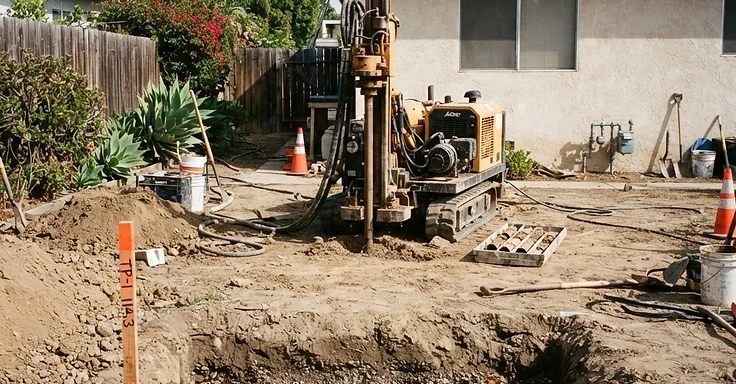
Soils Report Costs in Los Angeles
You can search online for a residential soils report and see national sites quoting $1,500 to $3,000. But if you’re building an ADU or adding a room here in LA, those numbers are off. We’re working on a tectonic basin. It’s full of alluvial deposits, old riverbeds, steep slopes, and active fault zones. Because of this, the LADBS holds us to some of the strictest geotechnical standards in the country.
A lot of our clients get hit with this requirement right in the middle of the permit process. You’ve got your plans for that detached ADU or new bedroom suite ready to go. You submit to the city. Then, the plan check correction letter arrives. It demands an approved Soils and Geology Report before they’ll even look at your structural plans. This adds thousands in engineering fees, hits you with more city plan check charges, and stalls your project for eight to fourteen weeks while the Grading Division reviews the paperwork.
And the report itself changes the game. What the engineer writes dictates your foundation design. If they find unstable sand, expansive clay, or undocumented fill, that straightforward slab-on-grade is off the table. You’ll be looking at an engineered foundation with grade beams and friction piles. That drives up your actual construction costs fast. In this guide, we break down the municipal code triggers, 2026 engineering and review costs, and what you can do to check your parcel before you pay for blueprints.
Key Takeaways
- LADBS exempts one-story additions under 500 square feet from soils reports if your lot is flat, sits outside geohazard zones, and doesn't involve cutting or filling slopes steeper than five feet.
- If your property is in an LADBS Hillside Grading Area, a State of California Liquefaction Zone, or an Earthquake-Induced Landslide Zone, you are getting a geotechnical investigation regardless of how small your project is.
- We usually see flatland site investigations run between $5,500 and $9,500. But if you are on a steep, limited-access hillside parcel, expect to pay $10,000 to $18,000 or more.
- So, once you submit that report, the LADBS Grading Division charges a review fee between $1,800 and $3,200. You also need to wait eight to fourteen weeks for them to sign off before we can pull your structural permits.
- Soil conditions drive foundation prices up fast. A standard slab costs about $18,000, but if the report calls for grade beams, deepened continuous footings, or drilled concrete piles, that bill jumps to $35,000 to $65,000 or more.
The Code: When LADBS Mandates a Soils and Geology Report
LADBS handles earthwork and foundations under Chapter 18 and Chapter 70 of the Los Angeles Municipal Code. They follow the California Building Standards Commission codes. Per code section 91.1803, LADBS wants a foundation investigation if your soil looks questionable, contains expansive clays, or might fail.
You might think a ground-up addition or a detached ADU gets a free pass on standard prescriptive footings. That works on flat lots with no red flags. But LA is tricky. The city has special hazard zones. LADBS plan checkers use strict checklists. If your property hits any of these, we have to get a soils report:
- Hillside Grading Area: If your lot sits in the LA Hillside Grading Area, almost every new footprint, detached ADU, or foundation job needs a site-specific geotechnical and geology report.
- CGS Liquefaction Zones: Under the Seismic Hazards Mapping Act, you need a geotechnical analysis if you are in a liquefaction zone. We have to prove the sand won't lose strength during a big quake.
- Earthquake-Induced Landslide Zones: If your land is on a slope prone to sliding, you need a slope stability analysis. It has to show a safety factor of 1.5 under static conditions.
- Fault Rupture Study Areas: If you are in an Alquist-Priolo Earthquake Fault Zone or an LADBS Fault Rupture Study Area, you need a trenching study. This tells us how far we have to build from the fault line.
- Significant Cuts and Fills: Any grading that cuts or fills more than five feet vertically forces a formal report.
- Retaining Walls Over Four Feet: If your retaining wall is taller than four feet from the bottom of the footing, or if it holds up a driveway or another building, you need a soils engineer to run the numbers.
The Flatland Exemption: When You Can Skip the Report
Can we skip the report? Sometimes. But the rules are tight. LADBS will only waive a geotechnical report for small projects if you meet these conditions:
- The addition is one story, for a single-family house, and is under 500 square feet.
- You are totally clear of Hillside, Liquefaction, Landslide, and Fault Hazard zones.
- The site is flat. The slope cannot exceed 10 to 1.
- Your foundation doesn't put pressure on slopes or existing retaining walls.
- Your engineer uses standard concrete perimeter footings based on code-prescriptive values. We usually assume a soil bearing pressure of 1,000 to 1,500 pounds per square foot.
If you check every one of these boxes, your engineer can design to standard code. That keeps you out of the LADBS Grading Division. But if you go two stories, pass 500 square feet, or hit a hazard zone, that exemption is gone.
How to Verify Your Property Hazard Layers on ZIMAS
You don't need to pay an engineer to see if your dirt requires a soils report. The City of Los Angeles keeps a public database called ZIMAS. We use it all the time. You can check your own hazard designations in five minutes by following these steps:
- Go to the portal at zimas.lacity.org.
- Type your house number and street name into the search bar on the left.
- Wait for your parcel to highlight on the map. Then, open the Zoning tab on the left. Look for the line labeled Hillside Grading Area. If it says "Yes", LADBS sees your property as a hillside site. It doesn't matter if your yard looks flat.
- Next, expand the Seismic Hazards tab. Check these rows: Landslide Area, Liquefaction Zone, and Fault Rupture Study Area.
- If any of these say "Yes", write that down. That one flag means you'll need a geotechnical investigation for any new foundation footprint.
So, you can also cross-reference state data through the California Geological Survey. They keep the official maps that LADBS uses for the municipal code. And catching these flags early stops you from paying for structural drawings you'll just have to redraw later.
The Cost Breakdown: 2026 Realities in Los Angeles
When a soils report is triggered in Los Angeles, your budget takes a hit in three areas: field engineering, city reviews, and construction upgrades. Here is what we see these components costing across Southern California in 2026.
1. The Geotechnical and Engineering Geology Report ($5,500 – $18,000+)
A real soils report isn't just paper. A California-licensed geotechnical engineer and a certified engineering geologist have to visit your lot, drill borings, pull core samples, run lab tests, and write up structural recommendations. Your final price depends on how hard it is to get to your site:
- Standard Flat Sites ($5,500 – $9,500): If your lot is flat and a truck-mounted drill rig can back right into the yard, you will usually pay in this range. The price covers two or three borings 10 to 20 feet deep, lab tests for moisture and density, and the report.
- Challenging or Hillside Sites ($10,000 – $18,000+): Building in the hills costs more. If a truck rig cannot reach your backyard, we have to bring in portable rigs or hand-auger crews. So, if the engineer needs to run slope stability calculations or map bedrock, your labor hours go up fast.
2. LADBS Grading Division Plan Review Fees ($1,800 – $3,200+)
You can't just hand a private engineering report to your building plan checker. It has to go to the LADBS Grading Division for a peer review. LADBS charges you based on your project square footage, how much earth you are moving, and your hazard zone. For most single-family additions and ADUs, expect to pay between $1,800 and $3,200. But if you are in a fault study area or have major grading work, the city will add extra surcharges.
3. Foundation Construction Premiums ($17,000 – $50,000+ Extra)
The most expensive part of a soils report is the foundation plan the engineer draws up. If they find uncertified fill, expansive clay, or unstable ground, you cannot use a standard shallow footing. Take a look at these comparative costs for an 800-square-foot detached ADU:
- Standard Prescriptive Slab on Compact Soil: $16,000 to $22,000. This is your standard 12-inch wide by 18-inch deep footing with a four-inch concrete slab, rebar, and vapor barriers.
- Deepened Footings with Sub-Excavation: $26,000 to $36,000. We see this when the engineer makes us dig out four to six feet of undocumented fill, re-compact the dirt, and deepen your perimeter footings.
- Friction Piles and Grade Beams: $45,000 to $75,000+. This is common for hillside builds or poor soil. We have to bring in a rig to drill eight to twelve concrete caissons 20 to 40 feet down into bedrock, then tie them together with heavy steel-reinforced grade beams.
These numbers are just planning ranges. Things like site access, concrete pumping, and the price of steel can drive these costs even higher.
The LADBS Grading Division Bottleneck: Timeline Sequencing
The biggest mistake we see from homeowners and designers is submitting structural plans without checking the Grading Division workflow. Permits in Los Angeles don't just move on one track. They involve reviews across multiple city departments that happen in parallel or sequence.
Once a soils report hits the desk, LADBS gives it to an engineering geologist and a geotechnical engineer. The process hits these steps:
- Submittal and Log-In: Your engineer sends the report with the grading review application and check. It sits in the queue until a specialist grabs it.
- Initial Review (6 to 10 Weeks): The reviewer checks your boring logs, calculations, and cross-sections against city grading memos and the California Building Code.
- Correction Letter vs. Approval: You rarely get an immediate green light. LADBS usually fires back a Soils and Geology Correction Letter asking for more lab testing, clearer data, or new math.
- Response and Re-Check (2 to 4 Weeks): Your geotechnical engineer has to grind through those city comments, write a formal response, fix the numbers, and send it back.
- Grading Approval Letter: Once they are happy, LADBS finally issues an official Soils and Geology Approval Letter with your structural conditions.
Here is the reality: your structural plan checker won't sign off on a thing until that Grading Approval Letter is in hand. If your designer submits building plans with standard footings while the soils report is still waiting, the structural review stops cold. But if the grading review forces you to use deeper piles or changes your bearing value, your structural engineer has to start over on the drawings. That costs you serious time. Budget for eight to fourteen weeks from your first submittal to get that final sign-off in 2026.
Foundation Mitigation Strategies and Smart Workarounds
We want to keep your project costs and timelines tight. You can't change the LA dirt, but we can use a few tactical moves to dodge heavy geotechnical headaches.
1. Keep Additions Under 500 Square Feet on Flat Sites
If you're on a flat lot and just need a home office or bedroom, try to cap it at 499 square feet. Staying under that 500-square-foot mark lets your architect use standard prescriptive footing tables under municipal code exemptions. So you skip the private report fee and the grading review bottleneck, as long as no other geohazards pop up.
2. Shift Your Footprint Outside Slope Influence Zones
In the hills, flat pads often sit right next to slopes. But if you place an ADU too close to the edge, the building puts pressure on the slope face. That forces you into slope stability modeling and soils reports. If we pull your footprint back away from the top or toe of the slope, we can show that the new building isn't pushing on the hillside. LADBS plan checkers might waive the whole hillside review if we keep the foundation on the stable, level part of the pad.
3. Utilize Existing Geotechnical Data
Was your home built in a modern subdivision or renovated in the last 10 to 15 years? A soils report might already be in the city archives. Check the LADBS online database to see what’s there for your address. We can't just recycle an old report for a new project, but your original engineer can often look at the old boring data. They might just drill one test hole instead of three and write an update letter. That saves you thousands in fees and gets you through the testing phase much faster.
Step-by-Step Checklist for Los Angeles Homeowners
Before you sign any architectural agreements or break ground on an ADU or room addition, use this checklist. We want to help you protect your budget and your timeline.
- Check ZIMAS First: Figure out if your lot sits in a Hillside Grading Area, Liquefaction Zone, Landslide Zone, or Fault Rupture Study Area. Do this before you hire an architect.
- Determine Your Actual Floor Area: See if your needs fit inside the 500-square-foot exemption limit if your property is on flat land outside those hazard zones.
- Interview Geotechnical Engineers Early: If your project needs a report, get bids from local firms that know the LADBS Grading Division examiners. Ask them if they will handle the first round of LADBS correction letters.
- Budget for Foundation Upgrades: Don't let your architect design a generic shallow slab before the soils engineer gives you the bearing capacities. So, keep a $15,000 to $30,000 foundation contingency if you're building in known liquefaction or hillside zones.
- Sequence Your Submittals Properly: Submit your soils and geology report to the LADBS Grading Division as early as you can. And don't wait for your structural framing drawings to finish before you start the geotechnical review.
- Verify Contractor Licensing: Heavy foundation work, pile drilling, and hillside excavations call for experienced structural crews. Make sure your builder has an active Class B General Building Contractor license in good standing with the Contractors State License Board and holds full workers' compensation and liability coverage.
How 1 Smart Build Can Guide Your Project
Lots of residential projects stall out when they hit the wall between city zoning, geotechnical engineering, and foundation work. We are a full-service design-build general contractor (CSLB #1076428) out of Woodland Hills. We handle projects for owners across Los Angeles.
We build the geotechnical reality right into our design process from day one. So, you don't end up with surprise structural corrections at the city counter. We pull your parcel data, check for soil triggers immediately, and coordinate with geotechnical engineers to design foundations that fit the actual soil profile of your lot.
But if you have an addition, a detached ADU, or a hillside project in the works, we can help you figure out your property risks and set a predictable budget. Use our online planning tool at 1smart.build/build-check to check your site. Or just call us at 1 (866) 419-8840 to talk to our design-build team.
DISCUSS YOUR PROJECT WITH 1 SMART BUILD
Licensed, bonded and insured design-build general contractor serving Los Angeles County and Southern California. Tell us about your property and goals, and we'll walk you through feasibility, permitting and a clear plan.