HOW TO LEGALIZE AN UNPERMITTED ROOM ADDITION OR GARAGE CONVERSION IN LOS ANGELES: A 2026 GUIDE
Learn the process for legalizing unpermitted home additions in Los Angeles, including investigation fees, destructive testing, and code compliance steps.

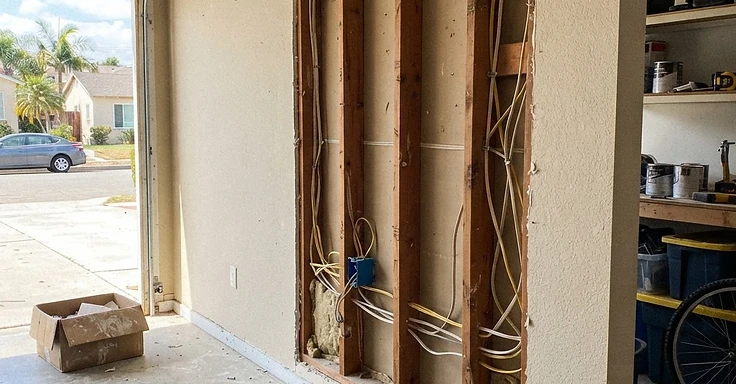
If you own a home in Los Angeles with a room addition or garage conversion built without permits, you are not alone. Many homeowners find themselves in this position, often inheriting these spaces from previous owners. While these areas add square footage, they also create a liability when you try to sell, refinance, or insure your property. In 2026, the City of Los Angeles continues to focus on housing safety, making the path to legalization clearer but technically rigorous.
Legalizing an unpermitted space is not just about paperwork. It is about making sure that the structure meets current life-safety standards. Whether you are looking to bring a bootleg guest room into the fold or turn a garage into a legal ADU, you need a systematic approach to bring the work up to the 2026 California Building Code.
Key Takeaways
- The LADBS Investigation Fee, per LAMC 98.0402, requires you to pay 200 percent of the standard permit fee for any work started without prior authorization.
- You should budget between $3,000 and $8,000 for as-built architectural and structural plans, depending on the complexity of the existing framing.
- Destructive testing is a requirement where inspectors will order the opening of drywall to verify electrical, plumbing, and shear wall nailing patterns.
- All legalized spaces must meet 2026 Title 24 energy standards, which often requires adding insulation in walls and roofs.
- Under California SB 13, you may be eligible for a 5-year delay in building code enforcement for certain ADU-related safety issues, provided the unit does not pose a direct threat to health and safety.
Understanding the LADBS Investigation Fee
The most immediate financial hurdle when legalizing unpermitted work is the investigation fee. Under LAMC 98.0402, the city imposes a penalty for work performed without a permit. This is not a flat fee. It is calculated as a percentage of the permit fee that would have been required if you had applied for the permit before starting construction. In practice, this effectively doubles your permit costs. You must account for this in your initial budget, as it is a standard part of bringing your property into compliance with the Los Angeles Department of Building and Safety (LADBS).
The Reality of Destructive Testing
When you submit plans for an as-built permit, the city does not just take your word that the structure is sound. Because the work was done without oversight, an inspector cannot verify what is hidden behind the walls. This is where destructive testing comes in. You will need to hire a contractor to open specific sections of your drywall, ceiling, and flooring. The inspector will look for proper electrical wiring methods, plumbing venting, and, most importantly, structural shear wall nailing. If the framing does not meet current seismic standards, you will be required to perform a structural upgrade, which can increase your project scope.
Meeting 2026 Title 24 Energy Standards
Bringing an unpermitted space up to code means it must comply with the current California Energy Commission Title 24 standards. This is often the most challenging part of the process for older, uninsulated additions. You will likely need to install modern insulation in the walls and roof to meet current R-value requirements. Additionally, if the space includes windows or doors, they must meet current U-factor and solar heat gain coefficient standards. For many homeowners, this means replacing older, single-pane windows with modern, energy-efficient alternatives. Consult the California Department of Housing and Community Development for further guidance on state-wide housing standards.
Practical Steps for Your Legalization Project
First, hire a licensed architect or structural engineer to perform an initial site assessment and create as-built drawings. You need these drawings to show the city exactly what exists on your property today.
Second, submit your plans to LADBS for plan check. Make sure you include all necessary energy compliance documentation. The city will review these to ensure that the work, once completed, will be safe for occupants.
Third, schedule a preliminary inspection. This is the moment where you and your contractor will identify exactly where destructive testing will be required. Expect to open up several areas of your walls so the inspector can see the structural and mechanical components.
Fourth, perform the necessary structural and energy-efficiency upgrades. Your contractor will guide you through the process of patching and retrofitting as identified by the inspector during the site visit.
Finally, schedule final inspections for building, electrical, and plumbing to close out the permit. Once these are signed off, your space is officially legal and recorded with the city.
The 5-Year Enforcement Delay for ADUs
If your unpermitted space qualifies as an Accessory Dwelling Unit, you may be able to use the provisions under California SB 13. This law allows for a 5-year delay in enforcing certain building code requirements, provided the unit does not pose a threat to health and safety. This is a helpful tool for homeowners who need time to save for the necessary upgrades. You must apply for this delay through the city, and keep in mind that this does not exempt you from eventually meeting code. It simply gives you a window of time to plan and save.
Planning Your Budget and Timeline
Legalization is not a fast process. You are looking at a timeline that often spans several months. You have to account for the time it takes to draw the plans, submit them to the city, wait for the plan check cycle, perform the physical work, and schedule the series of inspections. While it is tempting to rush, the city review process dictates the speed. Expect to pay for permits, plan checks, engineering fees, and contractor labor for the physical repairs. Having a professional on your side helps you avoid common pitfalls that lead to plan check corrections, which only add more time and cost to your project.
How 1 Smart Build Can Help
Navigating the LADBS legalization process is complex, but you do not have to do it alone. At 1 Smart Build, we specialize in design-build projects that bring existing, non-compliant structures into full legal standing. We handle the architectural plans, the structural engineering, and the coordination with city inspectors to make sure your project moves forward. If you are ready to legalize your space and add value to your home, contact us today at (866) 419-8840 to start your consultation.
DISCUSS YOUR PROJECT WITH 1 SMART BUILD
Licensed, bonded and insured design-build general contractor serving Los Angeles County and Southern California. Tell us about your property and goals, and we'll walk you through feasibility, permitting and a clear plan.