California's Zone 0 Fire Rules Are Here: What Southern California Homeowners Must Do Right Now
California's new Zone 0 defensible space regulations took effect September 2026, requiring a 5-foot ember-resistant perimeter around homes in fire zones. Here's what LA, Ventura, and Orange County homeowners must do, what it costs, and how State Farm's return and the new wildfire recovery package change everything.
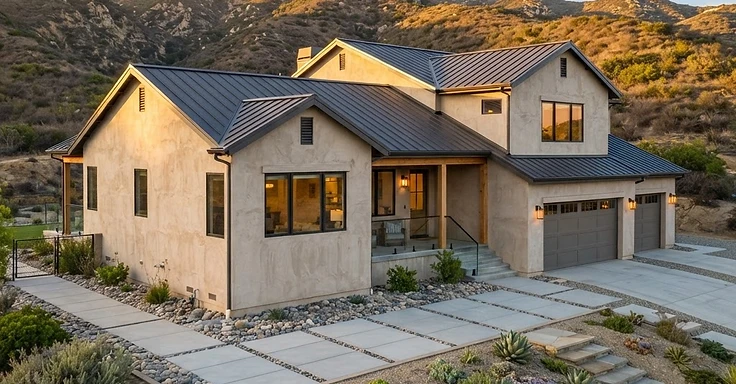
California Just Changed the Rules for the First Five Feet Around Your Home
On August 19, 2026, the California Board of Forestry and Fire Protection approved the state's first-ever Zone 0 defensible space regulations. These rules target the five feet immediately surrounding your home, the area where wind-driven embers do the most damage. If you live in a fire-prone area of Los Angeles, Ventura, or Orange County, this is not a future problem. New construction must comply now. Existing homes have a phased timeline, but the clock is already ticking.
And it is not just the government paying attention. On September 16, State Farm filed new underwriting guidelines that tie homeowners insurance to wildfire preparedness standards that go hand in hand with Zone 0. Three days earlier, Governor Newsom signed a wildfire recovery package that creates first-in-the-nation smoke damage standards and extends mortgage relief for fire survivors. The message from Sacramento and the insurance industry is the same: harden your home, or pay the price.
Here is exactly what changed, who is affected, what it will cost, and what you should do right now.
What Is Zone 0 and Why Does It Matter?
California has required defensible space around homes in fire-prone areas for years under Public Resources Code 4291. That law requires 100 feet of cleared space around structures in State Responsibility Areas. But the old rules focused mostly on clearing brush and vegetation farther out from the house.
Zone 0 is different. It covers the first five feet from your exterior walls outward. This is where embers accumulate during a wildfire. They pile up against walls, settle under eaves, drift into vents, and land on landscaping mulch right next to the foundation. Fire researchers have found that this immediate zone is where most homes actually ignite, not from the fire front itself but from ember showers that can travel a mile or more ahead of the flames.
The new regulations create a framework for making that five-foot perimeter resistant to ember ignition. The Board approved the final draft on August 19, 2026, and the package is now going through the Office of Administrative Law for final review before publication by the Secretary of State.
Who Is Affected?
Zone 0 does not apply to every property in California. It applies to homes and structures in:
- State Responsibility Areas (SRA), where CAL FIRE has primary fire protection responsibility. This includes large parts of unincorporated Los Angeles County, Ventura County, and Orange County foothill and canyon areas.
- Very High Fire Hazard Severity Zones (VHFHSZ) within Local Responsibility Areas (LRA). These are mapped by CAL FIRE and adopted by local jurisdictions.
In Los Angeles, VHFHSZ neighborhoods include the Hollywood Hills, Pacific Palisades, Bel Air, Brentwood, Sherman Oaks south of Ventura Boulevard, Encino, Tarzana, Woodland Hills, Topanga, Malibu, Calabasas, Altadena, La Canada Flintridge, La Crescenta, and Sunland-Tujunga. In Ventura County, the rules hit Ojai, Simi Valley, Santa Paula, Fillmore, and the Camarillo hills. In Orange County, affected areas include Laguna Beach, Anaheim Hills, Yorba Linda, Silverado Canyon, and Trabuco Canyon.
You can check your property's designation on the CAL FIRE Fire Hazard Severity Zone maps. Do not assume your property is exempt just because your street looks suburban. Many VHFHSZ boundaries run right through dense neighborhoods.
What the Rules Actually Require
The final approved framework divides Zone 0 into two sub-areas with different standards.
The Immediate Safety Zone
This is the area immediately alongside the structure. It generally extends at least one foot from the wall, and farther where necessary to reach the drip line of your eaves. If your house has two-foot eaves, the safety zone extends two feet out beneath them.
Within this zone:
- No combustible vegetation within two feet of windows, doors, and vents
- No combustible vegetation within five feet of attached decks or deck-like features
- Non-combustible ground cover only (gravel, concrete, pavers, decomposed granite)
The Remaining Low-Combustibility Area
From the outer edge of the safety zone to the full five-foot mark, certain maintained vegetation can remain. This is where the rules are more nuanced than many homeowners expect:
- Properly spaced succulents
- Bulbs and flowers
- Certain low-growing groundcovers
- Maintained grass or lawn
- Potted plants in non-combustible, easily movable containers
Zone 0 is not a mandate for five feet of bare concrete around every house. It is a requirement to substantially reduce ignition opportunities immediately next to the structure.
What Has to Go
Within the full five-foot Zone 0, the following combustible materials must be removed:
- Bark and combustible mulch
- Wood chips
- Accumulated leaves, needles, and branches
- Firewood stored next to the house
- Dead or dying vegetation
- Other readily combustible materials
For many Southern California homes, that means decorative bark mulch installed against the foundation has to come out. That landscaping may have been there for decades. It is a real change.
Roofs and gutters must also be kept clear of combustible debris at all times.
Trees, Fences, and Sheds
Trees: Trees are not automatically prohibited within Zone 0, but they must be properly maintained. Branches must be kept away from chimneys, roofs, and eaves. Dead material must be removed. Lower limbs (ladder fuels) must be managed. Large trees generally need lower limbs removed from the bottom six feet. Smaller trees are treated proportionally.
Fences and gates: Wood fencing attached directly to the house will eventually need a five-foot non-combustible section where it connects to the structure. That could mean replacing the portion of a wood fence or gate nearest the house with metal or another compliant material. New combustible fences and gates should not be built within Zone 0, though repairs to existing fencing are allowed.
Sheds and outbuildings: Structures within Zone 0 must have non-combustible exterior roofs and walls. A wood shed five feet from your house will need to be upgraded or removed.
The Timeline: When You Need to Act
New construction: Must comply with Zone 0 once the regulation becomes effective after Office of Administrative Law review. If you are building a new home, an ADU, or an addition in a fire zone right now, your project will need to meet these standards.
Existing homes, Phase 1 (within 3 years):
- Remove combustible mulch, wood chips, and firewood from Zone 0
- Clear dead leaves and branches
- Clean roofs and gutters
- Remove dead or dying plants
- Appropriately maintain trees
- Modify vegetation within required safety areas
Existing homes, Phase 2 (within 5 years):
- Create the required under-eave safety area
- Replace combustible gate or fence sections connecting to the house
- Address sheds and other structures within Zone 0
Local jurisdictions will establish specific implementation timelines within this framework.
The Insurance Angle: State Farm's Return Changes Everything
On September 16, 2026, State Farm General filed new underwriting guidelines with the California Department of Insurance. For the first time since pulling out of the California market, State Farm is considering new policies for homes that earn a Wildfire Prepared Home designation from the Insurance Institute for Business & Home Safety (IBHS).
There are two levels of IBHS certification:
Base (Essential): For low to moderate fire risk properties. The first five feet around the house must be free of anything combustible. No grass, no flowers, no shrubs, no privacy hedges, no succulents, no trees, no wood mulch, no wood or vinyl fencing. Detached garages, sheds, and ADUs within 5 to 30 feet must be at least 10 feet from the house and from each other, each with its own five-foot non-combustible zone.
Plus (Enhanced): For high and very high fire risk properties. Everything in the Base level, plus: detached garages, sheds, ADUs, and other accessory structures cannot be within 30 feet of the house at all. Upgraded windows and doors, noncombustible siding, additional protection for eaves, soffits, gutters, skylights, and decks.
Here is the catch. State Farm proposes requiring the higher Plus standard for older homes in high-risk areas, even though IBHS describes that level as typically for new construction. On a standard 5,700-square-foot Los Angeles lot with a detached garage 15 feet from the house, the Plus standard may be physically impossible without moving structures closer to property lines, which just shifts the risk to your neighbor.
The point for homeowners is clear: insurance companies are now tying coverage to the same standards Zone 0 addresses. Hardening your home is no longer just about code compliance. It is about whether you can get insured at all.
The Wildfire Recovery Package: New Protections Signed Into Law
On September 15, 2026, Governor Newsom signed four bills that strengthen protections for wildfire survivors across California:
- AB 1642 (Harabedian): Creates first-in-the-nation standards for testing and remediating lead and asbestos contamination from wildfire smoke. Directs the Department of Toxic Substances Control and the California Air Resources Board to develop enforceable protocols. Science, not an insurance company's opinion, determines whether a home is safe to occupy.
- AB 1795 (Gipson): Requires insurers to cover lead and asbestos testing, remediation, and full restoration to pre-loss condition for smoke-damaged homes within a wildfire zone. Bars insurers from cutting off Additional Living Expense coverage until the home is actually remediated and safe.
- AB 1842 (Harabedian): Makes mortgage forbearance protections permanent for disaster-affected homeowners going forward. Creates a national model for giving families a path away from foreclosure.
- AB 1847 (Harabedian): Extends the Mortgage Relief Act for LA fire survivors, doubling the forbearance window from 12 months to 24 months and requiring servicers to offer deferred repayment until end of loan.
As of this week, local building departments have issued 8,450 permits for fire recovery rebuilding. The state has helped deploy Archistar, an AI-driven plan-check tool that identifies code issues before submission, cutting weeks or months off approval times. The Department of Insurance reports nearly 42,000 claims filed and $23.7 billion paid out.
If you are rebuilding after the Eaton or Palisades fires, these new laws give you stronger protections than ever before. If you are hardening your home to prevent the next fire, Zone 0 and the IBHS standards tell you exactly what to do.
What It Costs to Comply
Rough numbers for a typical Southern California home in a fire zone:
- Ember-resistant vents: $40 to $80 per vent installed (Vulcan, Brandguard, or O'Hagin). Most homes need 10 to 20 vents. Total: $400 to $1,600.
- Removing bark mulch and replacing with gravel or pavers: $3 to $12 per square foot depending on material. A 200-linear-foot perimeter at 5 feet wide is about 1,000 square feet. Total: $3,000 to $12,000.
- Replacing wood fence section at house connection: $500 to $2,000 for a 5-foot non-combustible section with metal or composite panels.
- Non-combustible siding upgrade: $10 to $25 per square foot for fiber cement or stucco over wood siding. A 1,500-square-foot home exterior runs $15,000 to $37,500.
- Class A roof replacement: $12,000 to $30,000 for a typical 2,000-square-foot roof with fire-rated asphalt or metal.
- Window and door upgrades (IBHS Plus): Tempered glass windows run $500 to $1,200 each. A home with 15 windows: $7,500 to $18,000.
Phase 1 compliance (mulch removal, gutter cleaning, tree trimming, dead vegetation removal) can be done for a few thousand dollars or less if you do some of the work yourself. Phase 2 (fence sections, shed upgrades, eave modifications) runs higher. Full IBHS Plus certification for a high-risk property can easily exceed $50,000 in structural upgrades.
None of this is cheap. But compare it to losing your home and fighting your insurance company for two years. The math speaks for itself.
Five Things You Should Do Right Now
- Check your fire zone designation. Look up your address on the CAL FIRE FHSZ maps. If you are in an SRA or VHFHSZ, these rules apply to you.
- Walk your perimeter. Take a tape measure and check what is within five feet of your exterior walls. Bark mulch? Firewood? Shrubs under windows? Wood fence attached to the house? Make a list.
- Start Phase 1 this month. Remove combustible mulch, firewood, and dead vegetation from the first five feet. Clean your roof and gutters. Trim tree limbs away from the roof and eaves. This is the cheapest, highest-impact work you can do.
- Inventory your vents. Count every exterior vent and plan to replace them with ember-resistant models. This is the single most cost-effective hardening upgrade.
- Talk to your insurance agent. Ask whether your insurer or prospective insurers require IBHS Wildfire Prepared Home certification. If State Farm's new guidelines apply to you, find out which level you need and what it will take to qualify.
How 1 Smart Build Can Help
If you are in a VHFHSZ and need to harden your home, we can help. We handle the structural work that goes with Zone 0 compliance: ember-resistant vent installation, non-combustible siding replacement, fence and gate modifications, shed upgrades, deck hardening, and full fire-rebuild construction. We work in Los Angeles, Ventura, and Orange County. We know the local building departments, the fire code requirements, and the IBHS standards.
Call us at 1-866-419-8840, email info@1smart.build, or visit 1smart.build to schedule a home hardening assessment.
Related reading: The 2026 Los Angeles Homeowner Guide to Fire Sprinkler Retrofits, Avoiding Occupancy Delays: The LA Fire Rebuild Utility Sequence, The Los Angeles 110% Fire Rebuild Rule: What You Can Actually Build
DISCUSS YOUR PROJECT WITH 1 SMART BUILD
Licensed, bonded and insured design-build general contractor serving Los Angeles County and Southern California. Tell us about your property and goals, and we'll walk you through feasibility, permitting and a clear plan.